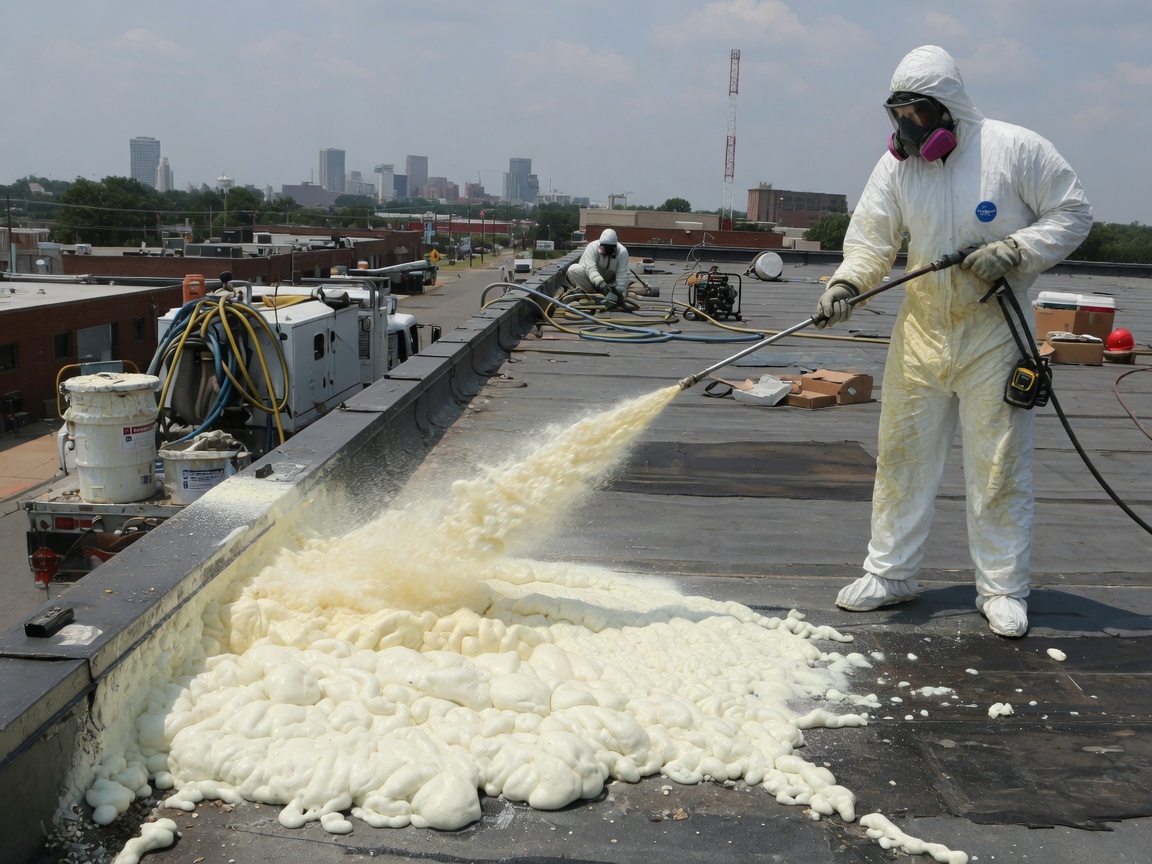
Tulsa's housing stock from the 1920s through 1970s in neighborhoods like Maple Ridge and Greenwood often features flat or low-slope roofs on brick and frame homes that collect water during the county's frequent severe thunderstorms. Spray foam roofing creates a seamless monolithic layer that seals seams and penetrations where traditional membranes fail under repeated freeze-thaw cycles in winter. Closed-cell foam also adds structural rigidity to older decks that have weakened from decades of humidity and temperature swings between summer highs and January lows.
Application thickness must account for Tulsa's high summer humidity that slows cure times and can trap moisture if the roof is not properly prepped after a storm. Technicians at 6549 E 46th St routinely check for existing tar and gravel buildup common on BOK Center-area commercial conversions and Pearl District rehabs before spraying. Open-cell foam is avoided on roofing decks here because it absorbs water during the region's heavy spring rains, while closed-cell formulations with higher R-value per inch perform better against both heat gain and winter heat loss.
Edge cases include wind-driven rain at Cain's Ballroom rooftops and the need for proper drainage around Philbrook Museum-adjacent properties where mature trees drop debris that clogs scuppers. Local code in Tulsa County requires minimum uplift ratings on commercial re-roofs, which spray foam meets when applied at the correct density. Homeowners in Brookside and Utica Square frequently request this system because it eliminates the need for tear-off on aging asphalt built-up roofs while adding insulation value in one step.
Technician insight
In Tulsa, the thing that catches most people out with Spray Foam Roofing is how quickly severe thunderstorms drop heavy rain on flat decks in Maple Ridge and Greenwood before the foam has fully cured. Older tar-and-gravel roofs common in those neighborhoods hold hidden moisture that must be dried out first or the new foam blisters within a season.
Brookside Flat Roof Restoration
A 1960s brick home in Brookside showed repeated leaks after spring storms. Inspection revealed cracked built-up roofing and poor drainage around scuppers. Closed-cell spray foam was applied over the prepared deck with a reflective coating to restore the surface and improve insulation value.
Spray Foam Roofing Services We Offer
✓Closed Cell Spray Foam Roofing
Applies high-density closed-cell foam directly to roof decks in Downtown Tulsa and Cherry Street properties to seal leaks and add structural strength against severe thunderstorms.
✓Roof Deck Insulation Upgrade
Increases thermal performance on older low-slope roofs in Maple Ridge and Greenwood by spraying closed-cell foam that resists both summer humidity and winter cold.
✓Flat Roof Restoration
Restores aging built-up roofs on commercial buildings near the BOK Center and Route 66 Historical Village without full tear-off using spray foam and reflective coating.
✓Attic to Roof Transition Sealing
Seals the transition between attic and roof deck in Jenks and Bixby homes to stop air leakage where warm humid summers meet cold winter air.
✓Storm Damage Roof Repair
Repairs hail and wind damage on roofs in Owasso and Broken Arrow by filling punctures and cracks with spray foam before recoating.
Spray Foam Roofing Cost in Tulsa, OK
| Service | Typical Range | What Affects It |
|---|---|---|
| Spray Foam Roofing Application | $2.50–$4.50 per sq ft | Varies with thickness, deck condition, and number of penetrations on older Tulsa homes. |
| Protective Coating | $1.00–$1.75 per sq ft | Added layer required for UV protection in high-sun exposures. |
| Storm Damage Patching | $800–$2,200 | Depends on extent of hail or wind damage in areas like Jenks and Owasso. |
Ranges are typical for Tulsa, OK and confirmed with an exact written quote before any work starts.
How it works
- 1
Site Assessment
Inspect roof condition, deck type, and drainage on properties in Tulsa County neighborhoods while noting exposure to severe thunderstorms.
- 2
Surface Preparation
Clean debris, repair minor deck damage, and ensure the surface is dry after recent rain common in the region.
- 3
Foam Application
Spray closed-cell foam in controlled passes to achieve required thickness and adhesion on flat or low-slope roofs.
- 4
Protective Coating
Apply UV-resistant elastomeric coating to protect the foam from Oklahoma sun and weather extremes.
- 5
Final Walkthrough
Verify drainage, check seams, and confirm the system meets local performance expectations.
Pricing
Pricing depends on roof size, slope, existing condition, and access; quotes provided after on-site assessment.